EXAMPLE: Nitrifying biofilm
In wastewater treatment, biofilm systems are often used for nitrification. Nitrifying bacteria are notoriously slow-growing, and biofilm reactor are good at retaining them in the system. They can be used both for treatment of the main wastewater and sludge liquor (reject water), which is a ammonium-rich water genereted during sludge treatment. Here, we will simulate the development of biofilms treating sludge liquor.
Step 1: Define the influent
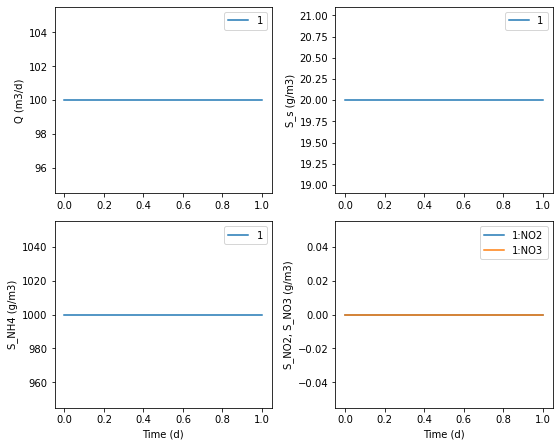
I will use an influent having a constant flow of 100 m\(^{3}\)/d, a biodegradable COD concentration of 20 g/m\(^{3}\) and an ammonium-nitrogen concentration of 1000 g/m\(^{3}\). This type of constant influent can be defined as a python dictionary, as follows: ```
[1]:
influent = {'Q':100, 'S_s':20, 'S_NH4':1000}
Step 2: Set up the reactor
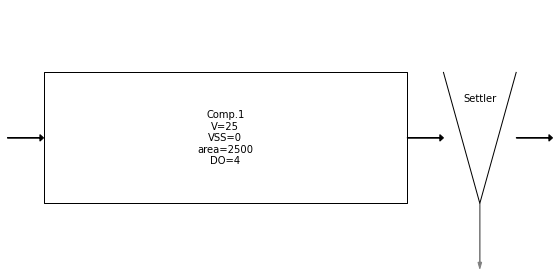
We will assume a completely stirred tank reactor, thus we will only use one compartment in the reactor model. I will use a volume of 25 m\(^{3}\), which will result in a hydraulic residence time of 6 hours. I will set the biofilm area to 2500 m\(^{2}\), which corresponds to a specific biofilm area of 100 m\(^{2}\)/m:math:^{3}. The maximum biofilm thickness (Lmax) is set to 400 \(\mu\)m and the diffusion boundary layer between the bulk liquid and the biofilm (DBL) is set to 10 \(\mu\)m .
Since it is a pure biofilm reactor, I set VSS=0.
I specify a bulk liquid dissolved oxygen concentration (DO) of 4 g/m\(^{3}\).
The influent is specified as the variable influent we defined above.
After these lines of code, the reactor system is saved in the variable r. I can check the reactor system using the method view_process(). I can also check the influent using the method view_influent().
[2]:
import biops
import numpy as np
r = biops.ifas.Reactor(influent=influent, volume=25, DO=4, VSS=0, area=2500, Lmax=400*10**-6, DBL=10*10**-6)
r.view_process()
r.view_influent()
Step 3: Run simulation
[3]:
%matplotlib notebook
import matplotlib.pyplot as plt
import time

#Here we set up a multi-panel figure to plot COD, total nitrogen (TN), individual nitrogen species, and biomass composition
plt.rcParams.update({'font.size':10}) #Defines fontsize to use for the axes in the figure
fig, ax = plt.subplots(nrows=2, ncols=2, figsize=(20/2.54, 13/2.54)) #Defines number of panels and figure size
ax[0, 0].set_title('COD (g/m3)', fontsize=10)
ax[0, 1].set_title('TN (g/m3)', fontsize=10)
ax[1, 0].set_title('NH4 (g/m3)', fontsize=10)
ax[1, 1].set_title('NO2(red), NO3(blue) (g/m3)', fontsize=10)
ax[1, 0].set_xlabel('Time (d)')
ax[1, 1].set_xlabel('Time (d)')

fig.tight_layout()

#Here we run a loop for 60 time steps. The default setting is that each time step is one day, so this corresponds to about two monthsge
for i in range(60):
    r.calculate() #This runs the calculation for one time step

    #In the first panel we plot influent and effluent COD concentrations
    ax[0, 0].plot(r.bulklogger['1']['Conc'].index, r.bulklogger['1']['Conc']['S_s'], color='grey')

    #In the second panel we plot influent and effluent TN concentrations
    ax[0, 1].plot(r.bulklogger['1']['Conc'].index, r.bulklogger['1']['Conc'][['S_NH4', 'S_NO2', 'S_NO3']].sum(axis=1), color='grey')

    #In the third panel we plot individual N species in the effluent
    ax[1, 0].plot(r.bulklogger['1']['Conc'].index, r.bulklogger['1']['Conc']['S_NH4'], color='grey')

    #In the fourth panel we plot individual N species in the effluent
    ax[1, 1].plot(r.bulklogger['1']['Conc'].index, r.bulklogger['1']['Conc']['S_NO2'], color='red')
    ax[1, 1].plot(r.bulklogger['1']['Conc'].index, r.bulklogger['1']['Conc']['S_NO3'], color='blue')

    fig.canvas.draw()
    time.sleep(0.05) #This is to slow down the calculations a bit so we can see the figure dynamically updating

Step 4: Explore the biofilm profiles
In the plots above, we see the concentrations in the effluent from the reactor. To find what happened inside the biofilm we can have a look at the information stored in r.biofilmlogger. Data is stored at each time point. I will first check which time points we have available.
[4]:
print(sorted(r.biofilmlogger['1']['Conc'].keys()))
[0, 1.0, 2.0, 3.0, 4.0, 5.0, 6.0, 7.0, 8.0, 9.0, 10.0, 11.0, 12.0, 13.0, 14.0, 15.0, 16.0, 17.0, 18.0, 19.0, 20.0, 21.0, 22.0, 23.0, 24.0, 25.0, 26.0, 27.0, 28.0, 29.0, 30.0, 31.0, 32.0, 33.0, 34.0, 35.0, 36.0, 37.0, 38.0, 39.0, 40.0, 41.0, 42.0, 43.0, 44.0, 45.0, 46.0, 47.0, 48.0, 49.0, 50.0, 51.0, 52.0, 53.0, 54.0, 55.0, 56.0, 57.0, 58.0, 59.0, 60.0]
I will plot concentration profiles of substrate and biomass components at two time points: day 20 and day 60.
[8]:
import matplotlib.pyplot as plt

plt.rcParams.update({'font.size':10}) #Defines fontsize to use for the axes in the figure
fig, ax = plt.subplots(nrows=3, ncols=2, figsize=(20/2.54, 17/2.54)) #Defines number of panels and figure size
ax[0, 0].set_title('DO (g/m3)', fontsize=10)
ax[0, 0].plot(r.biofilmlogger['1']['Conc'][20.0]['thickness']*10**6, r.biofilmlogger['1']['Conc'][20.0]['S_O2'], color='blue', label='Day 20')
ax[0, 0].plot(r.biofilmlogger['1']['Conc'][60.0]['thickness']*10**6, r.biofilmlogger['1']['Conc'][60.0]['S_O2'], color='red', label='Day 60')
ax[0, 0].legend()

ax[0, 1].set_title('NH4 (g/m3)', fontsize=10)
ax[0, 1].plot(r.biofilmlogger['1']['Conc'][20.0]['thickness']*10**6, r.biofilmlogger['1']['Conc'][20.0]['S_NH4'], color='blue', label='Day 20')
ax[0, 1].plot(r.biofilmlogger['1']['Conc'][60.0]['thickness']*10**6, r.biofilmlogger['1']['Conc'][60.0]['S_NH4'], color='red', label='Day 60')
ax[0, 1].legend()

ax[1, 0].set_title('NO2 (g/m3)', fontsize=10)
ax[1, 0].plot(r.biofilmlogger['1']['Conc'][20.0]['thickness']*10**6, r.biofilmlogger['1']['Conc'][20.0]['S_NO2'], color='blue', label='Day 20')
ax[1, 0].plot(r.biofilmlogger['1']['Conc'][60.0]['thickness']*10**6, r.biofilmlogger['1']['Conc'][60.0]['S_NO2'], color='red', label='Day 60')
ax[1, 0].legend()

ax[1, 1].set_title('NO3 (g/m3)', fontsize=10)
ax[1, 1].plot(r.biofilmlogger['1']['Conc'][20.0]['thickness']*10**6, r.biofilmlogger['1']['Conc'][20.0]['S_NO3'], color='blue', label='Day 20')
ax[1, 1].plot(r.biofilmlogger['1']['Conc'][60.0]['thickness']*10**6, r.biofilmlogger['1']['Conc'][60.0]['S_NO3'], color='red', label='Day 60')
ax[1, 1].legend()

ax[2, 0].set_title('Biomass (day 20)', fontsize=10)
ax[2, 0].plot(r.biofilmlogger['1']['Conc'][20.0]['thickness'][:-1]*10**6, r.biofilmlogger['1']['Conc'][20.0]['X_OHO'][:-1], color='blue', label='OHO')
ax[2, 0].plot(r.biofilmlogger['1']['Conc'][20.0]['thickness'][:-1]*10**6, r.biofilmlogger['1']['Conc'][20.0]['X_AOB'][:-1], color='red', label='AOB')
ax[2, 0].plot(r.biofilmlogger['1']['Conc'][20.0]['thickness'][:-1]*10**6, r.biofilmlogger['1']['Conc'][20.0]['X_NOB'][:-1], color='magenta', label='NOB')
ax[2, 0].plot(r.biofilmlogger['1']['Conc'][20.0]['thickness'][:-1]*10**6, r.biofilmlogger['1']['Conc'][20.0]['X_AMX'][:-1], color='green', label='Anammox')
ax[2, 0].plot(r.biofilmlogger['1']['Conc'][20.0]['thickness'][:-1]*10**6, r.biofilmlogger['1']['Conc'][20.0]['X_CMX'][:-1], color='orange', label='Comammox')
ax[2, 0].plot(r.biofilmlogger['1']['Conc'][20.0]['thickness'][:-1]*10**6, r.biofilmlogger['1']['Conc'][20.0]['X_I'][:-1], color='grey', label='Inert')

ax[2, 1].set_title('Biomass (day 60)', fontsize=10)
ax[2, 1].plot(r.biofilmlogger['1']['Conc'][60.0]['thickness'][:-1]*10**6, r.biofilmlogger['1']['Conc'][60.0]['X_OHO'][:-1], color='blue', label='OHO')
ax[2, 1].plot(r.biofilmlogger['1']['Conc'][60.0]['thickness'][:-1]*10**6, r.biofilmlogger['1']['Conc'][60.0]['X_AOB'][:-1], color='red', label='AOB')
ax[2, 1].plot(r.biofilmlogger['1']['Conc'][60.0]['thickness'][:-1]*10**6, r.biofilmlogger['1']['Conc'][60.0]['X_NOB'][:-1], color='magenta', label='NOB')
ax[2, 1].plot(r.biofilmlogger['1']['Conc'][60.0]['thickness'][:-1]*10**6, r.biofilmlogger['1']['Conc'][60.0]['X_AMX'][:-1], color='green', label='Anammox')
ax[2, 1].plot(r.biofilmlogger['1']['Conc'][60.0]['thickness'][:-1]*10**6, r.biofilmlogger['1']['Conc'][60.0]['X_CMX'][:-1], color='orange', label='Comammox')
ax[2, 1].plot(r.biofilmlogger['1']['Conc'][60.0]['thickness'][:-1]*10**6, r.biofilmlogger['1']['Conc'][60.0]['X_I'][:-1], color='grey', label='Inert')
ax[2, 1].legend(bbox_to_anchor=(1,1))

ax[2, 0].set_xlabel('Thickness (um)')
ax[2, 1].set_xlabel('Thickness (um)')
fig.tight_layout()

We see that the biofilm has grown to its maximum allowed thickness, 400 \(\mu\)m. At day 20, AOB are dominating the biofilm, we have a lot of nitrite in the water, and dissolved oxygen is completely consumed at a biofilm thickness of about 200 \(\mu\)m. At day 60, there is a balance between AOB and NOB and both ammonium and nitrite are almost completely removed from the bulk liquid. The amount of inert material in the biofilm has increased.
[ ]: